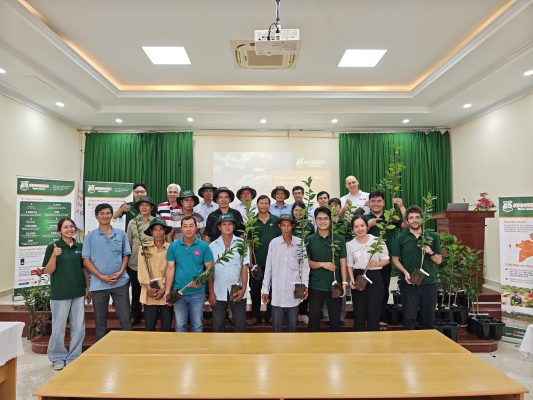
The SUCCEEDS project held its first nursery technical day at the demonstration nursery on the SOFRI campus in My Tho. Ten nursery owners from the Mekong Delta, together with professors from Can Tho University’s Plant Protection Department and agronomists from The Fruit Republic, joined the visit — the first time the nursery has been opened to an outside audience.
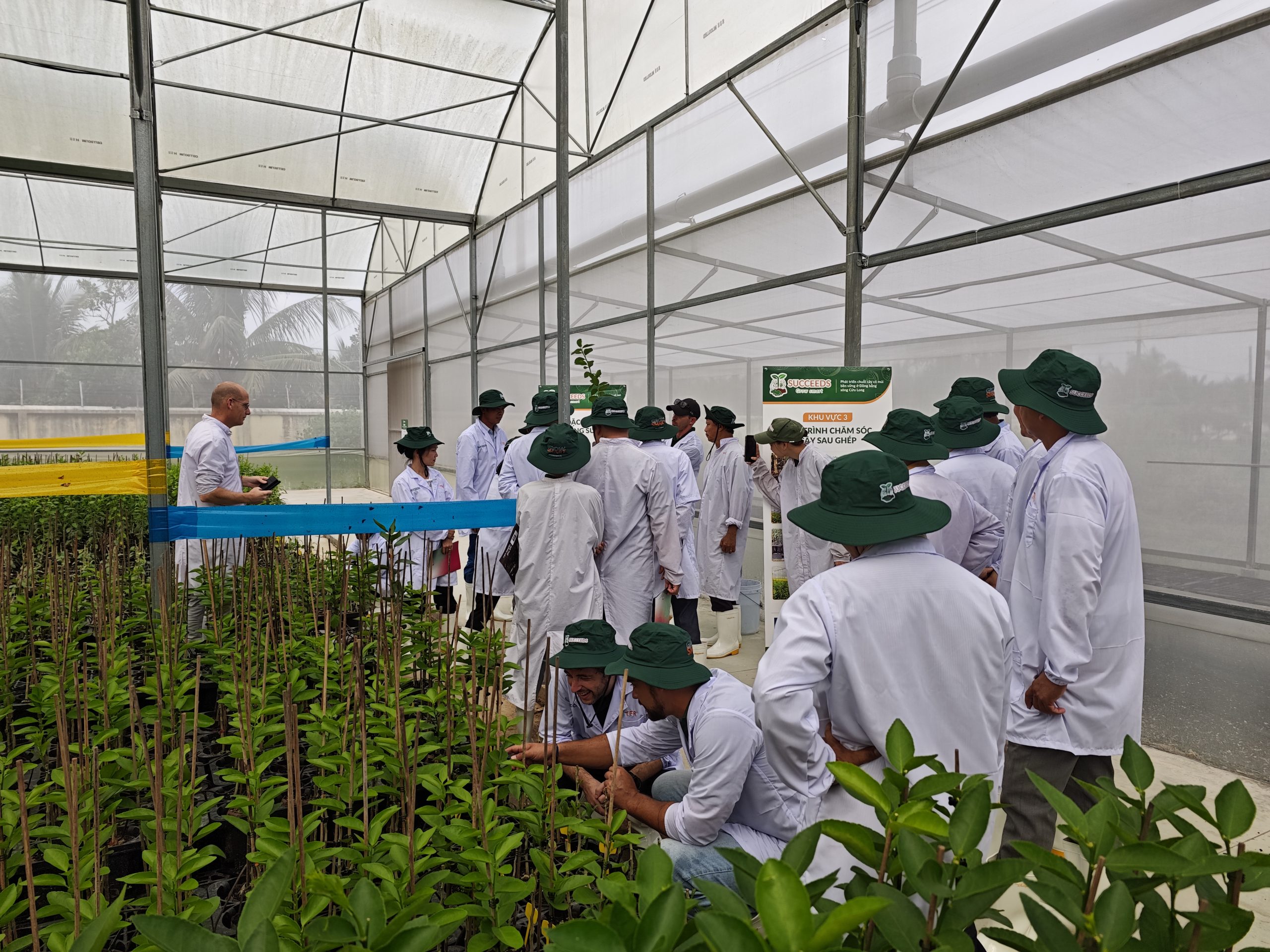 Participants attentively listening to the introduction of SUCCEEDS seedlings.
The SUCCEEDS demonstration nursery is the first professionalized citrus nursery in the Mekong Delta, with a production capacity of 50,000 seedlings per cycle. What sets it apart is the level of control at every stage. The facility is fully isolated from the outside environment to prevent disease transmission. Workers follow strict hygiene protocols and wear protective equipment. Seedling trays are raised to improve air circulation and reduce the risk of root rot, infections and nematodes. Integrated pest management is in place, with colour traps for insect monitoring and chemical control applied only when needed. Shade netting reduces sunlight intensity by around 50 per cent, creating better conditions for grafted rootstock development.
All propagation material entering the nursery is controlled. Seeds are selected for firmness, treated with fungicide, washed and dried before sowing. Budwood is sourced only from disease-free, mature mother trees. Every batch of seedlings leaving the nursery carries a detailed traceability log linking it back to the source material — a level of quality assurance that is new for the Mekong Delta citrus sector.
Seedlings move through five stages: germination (3–4 weeks), initial growth (2–3 months), post-grafting care (2 weeks), final growth (2–3 months) and a hardening-off phase before dispatch. The nursery uses automated drip irrigation combined with fertigation, with EC and pH levels monitored regularly. Air root pruning promotes straight, fibrous root systems, and bamboo stakes with clips keep stems upright to improve nutrient flow. The full cycle takes around seven months.
Fresh Studio, partner in the project, presented the substrates used across the production stages. The nursery uses GSA BVB growing media tailored to each phase: a fine-textured mix for seed germination, a medium-coarse blend with perlite for 50 mm pots during initial growth, and a coarser mix with perlite and bark for 120 mm pots in the final stage. Seedlings are grown in Ellepot biodegradable pots, which allow direct planting in the field without removing the pot, and reusable Ellepot trays designed for a ten-year lifespan.
After the presentations, participants walked through the nursery to see each production stage first-hand — from the insect-proof propagation rooms to the hardening-off zone — and could compare the root systems and canopy structure of nursery-grown seedlings with conventionally produced stock.
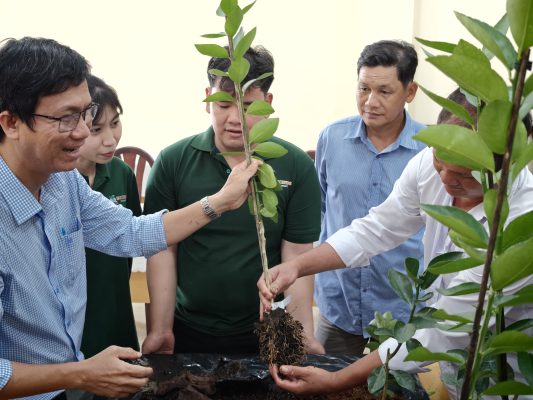
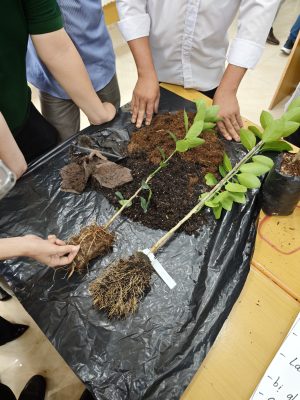 Participants discussing the differences between SUCCEEDS seedlings and locally produced seedlings.
The visit prompted a lively discussion on the differences between traditionally grown seedlings and those produced under the SUCCEEDS system. Participants were particularly impressed by the root quality, the biodegradable pot technology, the Ellepot aeration system and the systematic approach to the entire production process.
René van Rensen, Managing Partner of Fresh Studio, stressed the importance of focusing on quality — making the system better and more professional so that improvements carry through all the way to the field. That mindset, he said, also helps share knowledge with farmers and make the whole value chain more sustainable and profitable for everyone involved. Seedling production in Vietnam is developing fast, he noted, and it is important to keep up. Jacques added that a dedicated training programme on nursery management techniques will also be organized for the partner nurseries.
Mr Chin, the owner of a large nursery in Ben Tre, said the SUCCEEDS facility is a valuable model to learn from. He was particularly impressed by the protective netting system, which helps keep pests and diseases out of the nursery. He is also interested in the materials used for seedling bags and trays, which he could adopt at his own operation. In his view, nursery owners with sufficient resources could adopt the model in full, while those with tighter budgets should start with practical improvements and strengthen their practices step by step.
The technical day is part of a broader effort to raise nursery standards across the Mekong Delta. As the SUCCEEDS nursery scales toward full production capacity, the project will continue to organize knowledge-exchange events and provide direct support to the ten partner nurseries, working toward the goal of giving the region’s citrus farmers reliable access to healthier, stronger planting material.